

Howdy! This is Career Freelancer, weekly insights on how to embrace freelancing as a sustainable career path, not just a stopgap between roles. Learn what strategies professional freelancers adopt across disciplines to design careers on their terms.
Starting a freelance practice is difficult. Sustaining one for the long haul is far more complex.
But it’s not impossible and that’s what I’m here to help with. It doesn’t require next-level insights or savant-level intelligence. Instead, freelancing for the long term is the result of leveraging intentional practices and being strategic with how you show up each day.
This is the framework I’ve used throughout my 12-year career as a freelancer, and the approach I share with other freelancers on how to build a practice that’s profitable, sustainable, engaging, and focused on the future.
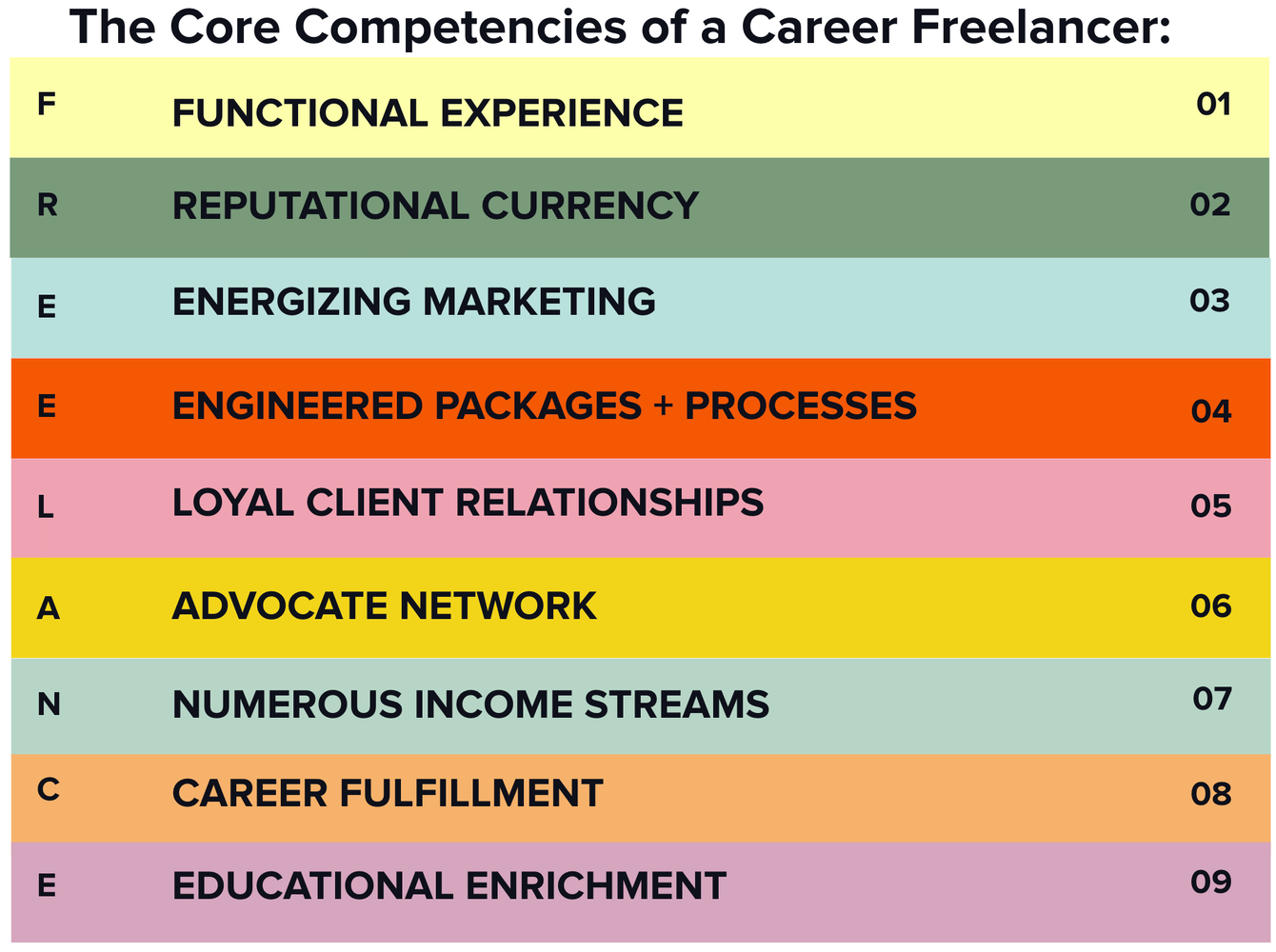
To best leverage this framework, think of each core competency across the FREELANCE acronym as aspects of your practice that you need to cultivate regularly. Maybe once a month or a few times a year. It’s not possible to tend to all these components at once, but being mindful of how you’re intentionally expanding upon each one as you navigate self-employment makes all the difference. Let’s dive in.
F — Functional Experience
Functional experience means ensuring you have varied and deep subject matter expertise across a few functions as a freelance professional. This is a foundational competency as experience in a particular industry is required in order for others to hire you, everything else won’t matter without it. You need deep immersion in at least one or two areas of a job function—whether that’s PR and internal communications, or HR and employee engagement.
Cultivating a strong background in a particular area of business that’s in demand is critical in order for you to come in as the outside expert to support an organization or work with clients where you understand their circumstances first hand. It’s important to have deep immersion in one or two areas but also be adaptable across complementary areas of expertise.
Typically, you’ll gain this from spending a few years building expertise in a particular job function as a full-time employee before diving into freelancing. But this can’t be a one-time effort. You need to continue growing and expanding this expertise so you remain an in-demand, of-the-moment subject matter expert, delivering value to partners and clients.
R — Reputational Currency
Reputational currency is third-party credentials, or what many call social proof. It’s signals from other established voices and institutions that you’re a credible expert, a quality freelancer, and someone to be trusted as a service provider and subject matter expert.
Reputational currency comes in many formats: teaching at a university, getting recommendations or testimonials from clients, writing for industry publications, landing speaking gigs, or earning certifications. You don’t need to pursue every credential out there, but you do need some reputational currency for new and existing clients to trust that you’re a well-qualified, up-to-date expert in your space that others vouch for.
What matters is gaining reputational currency that your clients value. The signals they see as indicators of trust. This helps with landing clients, earning referrals, and being trusted by your existing client base. As AI search continues to develop, these signals from established third parties like universities, industry publications, and platforms like Reddit will increasingly matter for continued visibility and credibility.
There once was a time when good work alone was enough. But as the market gets more competitive every year, earning outside credentials has become necessary to continue landing opportunities. You can’t rely on referrals alone as they won’t sustain you long-term.
E — Energizing Marketing
Building a thriving freelance practice requires committing to energizing marketing. That’s marketing that you can commit to regularly, that excites you as a freelancer, and that energizes your audience because it’s relevant to them and showcases your POV.
This could mean publishing on LinkedIn consistently, writing a newsletter, recording podcasts, writing for industry publications, appearing on other people’s podcasts, running a YouTube channel, or posting daily TikToks. Whatever the format, it needs to be something you can sustain for the long haul, whether you’re publishing weekly or bi-weekly, reaching your audience with subject matter you care about and that’s sustainable for you.
Referrals should be one way you attract work, but you have to put yourself out there with marketing too. This effort also helps from a sales perspective. After an introductory call or pitch meeting, you can send a video, article, or case study you’ve created that addresses their concerns or showcases a similar project, further illustrating the value you provide.
There’s no ideal cadence here. What matters is reaching your audience frequently enough on subjects you both care about, likely at least once a week for the foreseeable future.
E — Engineered Packages + Processes
Engineering your packages and establishing repeatable processes ensures your efforts are sustainable for the long term and reduces the likelihood of burnout or stretching yourself too thin. It also signals to new clients that you have a repeatable, strategic process in place, that you’re a qualified expert who’s done this numerous times before.
Engineered packages present your service offerings by outlining different components, deliverables, timelines, contributions expected from both sides, and of course, your pricing. These packages should provide a menu of options for different client needs and circumstances.
Clear, straightforward packages indicate a seasoned freelancer who’s not haphazardly fumbling together projects but has created systems to provide options aligned with client needs, then customized to their specific circumstances.
The process component is all about establishing straightforward internal systems to manage finances, existing clients, project management, performance tracking, and marketing. With the right tools and support systems, like other vendors or freelancers you work with, your practice can run more smoothly and be automated where it’s helpful.
L — Loyal Client Relationships
Once you land a client, there’s more work to be done to manage the relationship and increase the likelihood of a long-term collaboration with many future projects.
Think about client relationships the way an agency would: remove as much friction as possible, lead projects with a clear process and project management approach, communicate consistently, address evolving needs, set appropriate boundaries, and when possible, go above and beyond to personalize and provide tangible value.
Much of this is managing day-to-day relationships, ensuring everything goes as planned, owning up to mistakes, and over-communicating on progress and next steps. But it’s also about staying in touch after projects end. Follow up next quarter with an email checking in on programs you’ve supported, or follow them on LinkedIn and react to their posts.
The point is to provide value in small, doable ways like leaving a comment or sending an email, so when an opportunity arises in the future, you’re top of mind. Cultivate repeat partnerships by investing in lasting relationships, not one-off ventures, to sustain your business for the long haul.
A — Advocate Network
Building an advocate network means cultivating relationships with other freelancers and colleagues who will support you through the unique nuances of self employment. And you’ll return the favor of course, as it has to be a real relationship, not a transaction.
This includes befriending and supporting mentors, peer-level colleagues, and early-stage professionals. Each provides unique value to you and require different kinds of support from you based on where they are at experience and perspective wise. They help you expand your skills, recognize the range of opportunities for freelancers, understand how others organize their businesses, and better navigate common problems.
An advocate network can help refer freelance projects, act as a sounding board for ideas, and save you time solving problems unique to freelancing. It’ll probably be your best professional investment and the most rewarding as you’ll have numerous opportunities to help others.
Networking is never convenient, but taking time for a coffee, quick DM, or attending a three-day conference can help you find your version of professional satisfaction, understand the possibilities available to you, and generate more business and other opportunities you might not come across on your own.
This isn’t something you do just for your own benefit. You need to pour into these relationships and consistently provide value so they’re genuinely beneficial for both sides. I covered the subject of building a more communal freelance practice in this past edition.
N — Numerous Income Streams
Income diversity is critical for freelancers (and really anyone these days) to survive the slow periods, the ebbs and flows of particular industries, broader economic shifts, and technological innovations.
It’s in your best interest to have at least two to three different income streams as a freelancer. As your business evolves beyond the early stages and you commit to this as a long-term career path, ask yourself: How can I deliver services in different formats that add value to the same type of client or a complementary organization or industry? How do I protect myself from seasonality of demand and remain relevant?
Income diversity can mean offering courses, coaching, and consulting. It can mean having an Etsy shop, supporting event build-outs, and doing PR on the side. There’s no perfect mix. What matters is having a variety of income sources from different formats of work so you’re better protected, more engaged, and able to pivot intentionally to the types of work and expertise in demand at the moment because change is the only constant, as they say.
C — Career Fulfillment
One of the most important areas a freelancer can tend to is their own career satisfaction. Many freelancers stop going down the self-employment path because they fall out of love with what they originally committed to. They become disengaged, no longer enjoy it, and find it taxing and repetitive.
Plan ahead for those moments of disillusionment. Ensure at least some of your work mix is enjoyable, interesting, and intellectually engaging so you can stay focused and excited about showing up.
To be realistic, not all your work will be fun or interesting. But you need to set aside time to ensure that at least some percentage, even if it doesn’t significantly impact your bottom line, involves projects you enjoy, find engaging, and that help you grow as a professional.
E — Educational Enrichment
For the long-term prosperity of your freelance practice, you must invest in continuing education. This comes in many formats, but what matters is prioritizing both passive and active learning so your skills remain sharp, you’re still positioned as the expert in your area, and you’re updating your approach in line with the latest learnings, technology, and cultural shifts.
Passive learning includes daily and weekly async learning like listening to podcasts, reading books and articles, taking self-paced courses. This is light immersion so you’re aware of high-level concepts, trends, and emerging ideas on a frequent basis that’s easy to integrate into your schedule as it’s not too disruptive. Plus, this is self-directed learning on your own.
Active learning is much deeper immersion like taking a university course, attending a two-day workshop, meeting other professionals over coffee to learn what they’re doing. This is real-time, interactive learning where you’re getting deep exposure and practice building a skill with hands on exposure. This could be trying a marketing experiment, attending a conference with a colleague, or testing out a new AI productivity tool. The challenge is that active learning is more time-consuming, so it’s more difficult to incorporate into your schedule. So you’ll need to specifically allocate space on your calendar to expand skills, earn reputational currency through certifications, and commit to learning new areas.
That’s why it’s important to have a mix of both types of learning as each has its place in building upon your baseline knowledge and expanding your skills in brand new areas.
This framework isn’t about perfection. It’s about intentionality. You won’t be able to focus on all nine components at once, but by regularly checking in on each one and making strategic investments in your practice, you’ll build something that lasts. The goal is to make your freelance efforts profitable, sustainable, and genuinely fulfilling for years to come. 🧡
If this resonated, please subscribe for more, like doable shifts seasoned freelancers are making today to stay booked, prioritizing time off as a freelancer without losing clients, or positioning yourself as a leader as opposed to an outsourced employee.